Andreas Grün✕
| Home | Repertoire | Contact |
Charles Baron d’Aichelbourg
1782–1817
Duos for Mandolin and Guitar
Karl Stefan Freiherr von und zu Aichelburg was born in Vienna on 22 February 1782 into a distinguished aristocratic
family. His father Joseph belonged to the Croatian branch of the Aichelburg family, while his mother Regina was née Freiin
Wetzlar von Plankenstern. Both families moved in circles of intellectuals and artists; indeed, in
In 1801 the young Karl embarked on a military career in which he took part in two campaigns against France, received
distinctions for particular bravery, and served for three years on the general staff. In September 1812 he resigned
from military service, and two and a half years later he married Anna von Woroniecka, who came from an old Polish
family. — Karl’s way of life was evidently not the most solid: during his military years he had an extramarital
relationship with an actress, from which several children were born; and ultimately his extraordinarily large losses on
the stock exchange are said to have led to a “nervous fever” and thus to his early death on 6 December 1817.
Karl — as the musician Charles Baron d’Aichelbourg — was evidently a talented and skilful player
of the mandolin and guitar. He had a connection with Mauro Giuliani whose exact nature has not yet been fully clarified;
Giuliani dedicated to him the Grande Serenade for flute and guitar, op. 82, written around 1815. — In
1812 or 1813, the “Chemische Druckerey” of Sigmund Anton Steiner, one of the most important music publishers in Vienna at the
time, issued a series of four works under the name Charles Baron d’Aichelbourg, all for mandolin or violin and guitar.
(The French spelling of the family name — also used in Giuliani’s dedication — follows the tradition
of the Croatian branch of the Aichelburg family, which is why we retain it here when referring to Aichelburg as a musician.)
The works are: Pot-pourri, op. 1; Variations sur un théme original, op. 2; Notturno, op. 3; and
Variations sur la thême favorit de l’Opera Dite: Schweizerfamilie [sic!], op. 4.
Although d’Aichelbourg was only a “dilettante” as a musician — a term that originally carried no negative
connotation — and although his agreeable works largely follow the conventions of their time, several aspects of
his output nevertheless deserve our attention and make these rediscovered pieces a valuable addition to the mandolin literature
of the Viennese Classical period.
Quite apart from the already significant fact that d’Aichelbourg’s compositions enlarge the rather small surviving repertoire
of mandolin-and-guitar duos from the early nineteenth century with works that were previously completely unknown, they are also
of interest because of their musical texture. Compared, for example, with the duos of Leonhard
von Call, one notices that the mandolin is required to play more extended chordal passages, sequences of thirds, and even
chromatic octaves. The guitar has unmistakably outgrown the rather insignificant accompanying role it still played in the works
of Bartolomeo Bortolazzi: in the Notturno, for instance, it presents the very first theme and later contributes with
relatively varied accompanying figures to the shaping of musical character. In the fourth variation of op. 2 it is
required not only to play chords in the 14th (!) position, but also strikingly “modern” harmonic mixtures. To this are added
rhythmic subtleties of a kind rarely found in other guitar accompaniments of the period.
D’Aichelbourg’s Variations op. 4 were by no means the only work to draw on themes from Die Schweizerfamilie,
a harmless romantic love story. Soon after its premiere (1809), a flood of arrangements appeared, followed by numerous sets
of variations on the most popular melodies from this Singspiel, with which the already successful composer and Kapellmeister
of the Vienna Court Theatre, Joseph Weigl (1766–1846), finally achieved worldwide fame. Yet we form a misleading impression of
this stage work if we judge it solely by its popular melodies: although Weigl cleverly took advantage of the fashionable enthusiasm
of his compatriots for Switzerland in choosing such a subject, he does not employ Alpine musical idioms throughout, but — within
an otherwise conventionally classical-early-romantic style — uses them selectively, where they serve specific dramatic or
expressive purposes. A striking example is Emmeline’s cavatina, whose melody provided the theme for d’Aichelbourg’s variations.
Andreas Grün
I am indebted to the Viennese historian Dr. Wladimir Aichelburg for the information concerning the life and circumstances of Karl Stefan Freiherr von und zu Aichelburg.
 Variations sur un thème original, op. 2
Notturno, op. 3
Variations sur le thème favori de l'opéra dit « Schweizerfamilie », op. 4
Literature
 Andreas
Grün: Charles Baron d’Aichelbourg und seine vier Duos für Mandoline und Gitarre (PDF)
Andreas
Grün: Charles Baron d’Aichelbourg und seine vier Duos für Mandoline und Gitarre (PDF)
published in concertino 2/2007, pp. 82–90
Andreas Grün: Il Barone Charles d’Aichelbourg e i suoi quattro duetti per mandolino e chitarra
in il Fronimo no. 135, 2006, pp. 22–34
Music editions (first modern publications)
Variationen über ein eigenes Thema
for mandolin and guitar, ed. Andreas Grün, Musikverlag Vogt & Fritz, V&F 3026
 buy sheet music (www.edition49shop.de; PDF preview available)
Notturno
for mandolin and guitar, ed. Andreas Grün, Musikverlag Vogt & Fritz, V&F 3025
buy sheet music (www.edition49shop.de; PDF preview available)
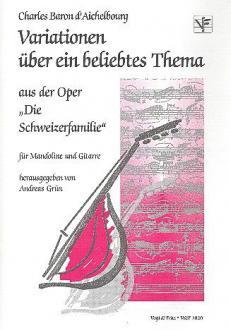
Variationen über ein beliebtes Thema aus der Oper „Die Schweizerfamilie“
for mandolin and guitar, ed. Andreas Grün, Musikverlag Vogt & Fritz, V&F 3020
buy sheet music (www.edition49shop.de; PDF preview available)
Errata – unfortunately, the guitar part contains three printing errors.
Theme: measure 8, third beat – the bass note must be G♯ instead of E.
Variation 4: measure 10, first bass note E instead of A; measure 11, third eighth note d♯¹ instead of d¹.