Andreas Grün✕
| Home | Repertoire | Contact |
Leonhard von Call
1767–1815
Chamber Music with Guitar
The works of the civil servant Leonhard von Call had one great advantage: they were also playable by amateurs.
The brilliant creations of the celebrated virtuosos were certainly admired in concert; but for music-making at home
with friends one was far more likely to turn to the manageable duos or trios of the k. k. Privy Chamber
Treasury’s liquidation adjunct. The pieces that von Call — born on 19 March 1767 in St. Pauls-Eppan (South
Tyrol) and whose name was often rendered in French fashion as “de Call” — performed in Viennese private
musical academies on the guitar “with extraordinary skill, grace, and effect” (Übersicht des gegenwärtigen
Zustandes der Tonkunst in Wien, 1808), were charming and simple enough to make their author one of the most popular and
successful composers of his time. As a contemporary reviewer put it: “Mr. de Call almost always strikes the right tone:
pleasant, agreeable, cheerful, light, and popular, without — save for a few passages — becoming
altogether trivial.”
Leonhard, the third of the five children Maria Theresia, née Heissler, bore to her husband Leonhard Balthasar von
Call, probably received his musical education in Bolzano. After serving in the Prussian army during the War of the
First Coalition against France, he evidently settled in Vienna in 1796, where he entered the service of the Imperial
Treasury. From 1802 onward his compositions began to appear with Viennese music publishers. In 1807, already forty
years of age, Call married the eighteen-years-younger Maria Wilhelmina Brabee, Edle von Franzenshuld. From this
union five children were born in the few years fate granted the family, yet only the daughter Adelheid Anna (*1810)
would survive both infancy and her father.
Call’s secure position seems to have provided the ideal framework for a life devoted to music. Free from financial
worries, he was able to dedicate his leisure entirely to his “beloved cytharra” (as he wrote in a letter to the
Weimar Kapellmeister August Müller) and to composition. Thus the number of his published works approaches 150,
and the largest part of his output consists of chamber music with guitar — surpassing even the considerable
number of works for male chorus: duos for various combinations, such as violin and guitar or mandolin and guitar;
numerous trios (mostly for flute, viola, and guitar); five quartets; and also three quintets for flute, strings,
and guitar.
When the not yet forty-eight-year-old died in Vienna on 19 February 1815 of what was then called “laryngeal consumption,”
the Allgemeine musikalische Zeitung wrote: “With him his family has lost a loving father, his companions of
youth a faithful brother, the fatherland an active citizen, and art an indefatigable promoter.” A century and a half
later, Wolfgang Matthäus observed in Die Musik in Geschichte und Gegenwart: “The anonymity of a bourgeois life
corresponds to the complete reception that Call’s work enjoyed within society. In the durability and breadth of this
reception, his work may be placed alongside that of the most important masters of his time.”
Andreas Grün
I am grateful to Mrs. Johanna von Call for the biographical information she kindly provided.
Edition
Serenade très facile, op. 55
for violin and guitar, ed. by Andreas Grün, Musikverlag Zimmermann, ZM 35520
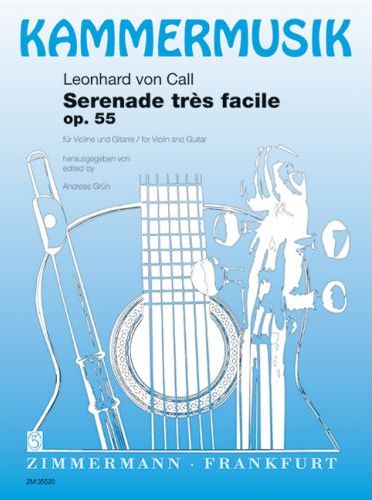
 buy sheet music (www.schott-music.com)